From AI adoption to content authority
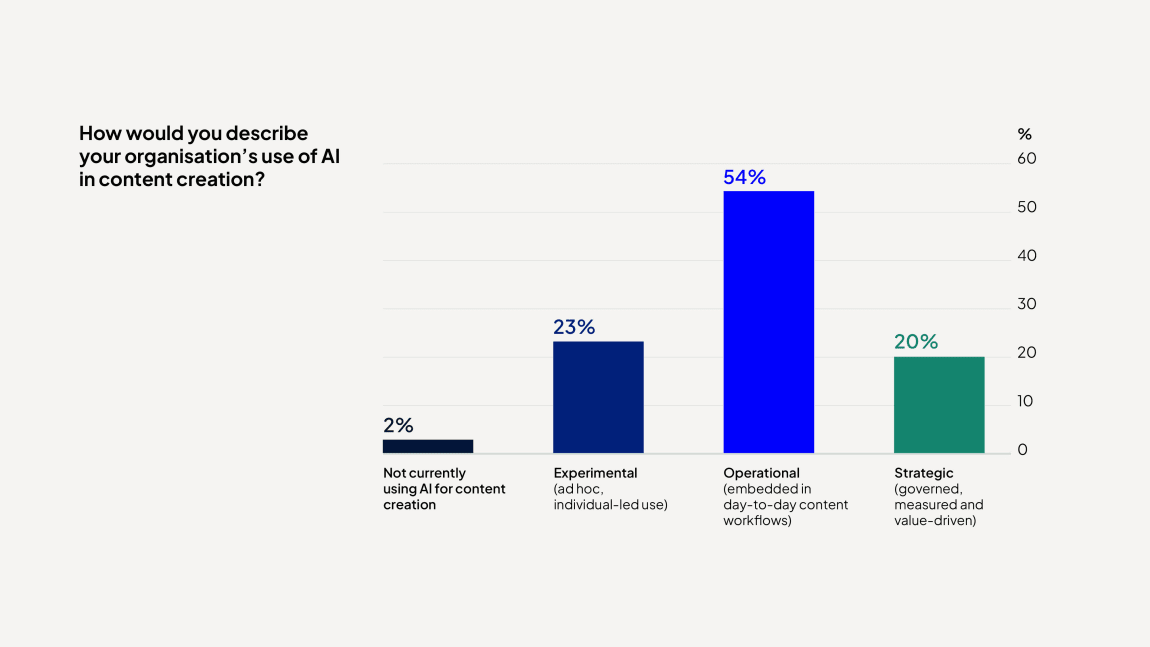
The past year has marked a turning point. Just 23% of respondents describe their organisation's use of AI in content creation as experimental. 54% say it is now embedded in day-to-day workflows. The technology has moved from curiosity to infrastructure faster than almost anyone anticipated, because the productivity gains are real.
Some of the capabilities now available to teams are remarkable. AI can accelerate drafting, support planning, rework material for different formats, and help teams move faster through parts of the process that once consumed huge amounts of time. It can free teams from some of the repetitive production work that has too often crowded out more strategic thinking.
AI's biggest impact today is in the way content is written, with 48% saying it has been transformational in this area. They also report significant improvements in ideation and planning, and in the ability to tailor and personalise content.
But there is a difference between using AI efficiently and using it well. Only 20% describe their organisation's use of AI as strategic, governed, measured and value-driven. That should ring alarm bells. It suggests that AI adoption is outpacing companies' ability to develop necessary regulations and standards to avoid adding to low-value AI slop.
It also reinforces the importance of developing strategies around People, Expertise, and Investment to ultimately ensure quality and influence.
The future is the corporate newsroom
We are still in the early stages of understanding what AI can and cannot do for content marketing. But one thing our study makes clear is that the fundamentals have not changed.
The content that builds trust, influences decisions and creates authority has always required the same things: original thinking, credible evidence, strong storytelling and a clear point of view. AI has made these even more important, because everything else is now easier to replicate.
The marketing leaders navigating this period most effectively share some common characteristics. They have invested in editorial authority alongside production capability. They have built the processes and the culture to get expertise out of people's heads and into content that genuinely influences the right audiences. And they are operating less like traditional marketing functions and more like a corporate newsroom — always-on, insight-led and built around a consistent presence that signals authority over time.
That shift is available to any organisation willing to make it. And for the leaders who do, this is one of the most exciting moments the profession has seen.
The influence gap
Satwant Wishart and Gareth Lofthouse discuss why greater efficiency doesn’t necessarily lead to greater influence, and the growing importance of quality, differentiation and original thinking.
Speakers: Satwant Wishart, Founder & CEO, Pandher Wishart Studios and Gareth Lofthouse, Founder & MD, Resonant
Satwant Wishart
So AI is certainly making us faster, it's making us more efficient. It's certainly making content making cheaper. But that's not necessarily equaling more influence, is it?
Gareth Lofthouse
No. And this gets us to the crux of well, a tension, if you like, in the research. When we asked respondents, are you getting more impact now versus 18 months ago? Only 20% say yes. But that's pretty disappointing given the efforts being thrown into this technology.
Satwant Wishart
And that is a real shame because we know that content should influence, it should engage, and ultimately, it should drive business growth.
And what's going wrong? The first challenge when it comes to using AI in content making comes down to differentiation. How do we say something and look different to our competitors when often we're talking about the same things and now we're using the same tools.
Next, when we're using AI, ensuring that it's factual and accurate. The faster we need to move, that's when it becomes even more essential to be fact-checking and ensuring that the quality of work doesn't drop.
Gareth Lofthouse
Companies are rushing to adopt, and maybe they're running before they can walk. Only 20% said they had this governance in place. That's a bit of a risk factor in. And maybe there could be a factual slip up. We've seen some pretty well-publicised stories where some major brands have got their fingers burnt on this.
For those I think companies will put their house in order on that.
What they're going to struggle with more is that point about an original insight, an original point of view.
There's a danger that we just use AI to pump up the volume and sort of spread the airwaves, if you like, with more mediocrity. Well, that's not actually going to do anything for anyone.