
The skills that will matter most in the age of AI
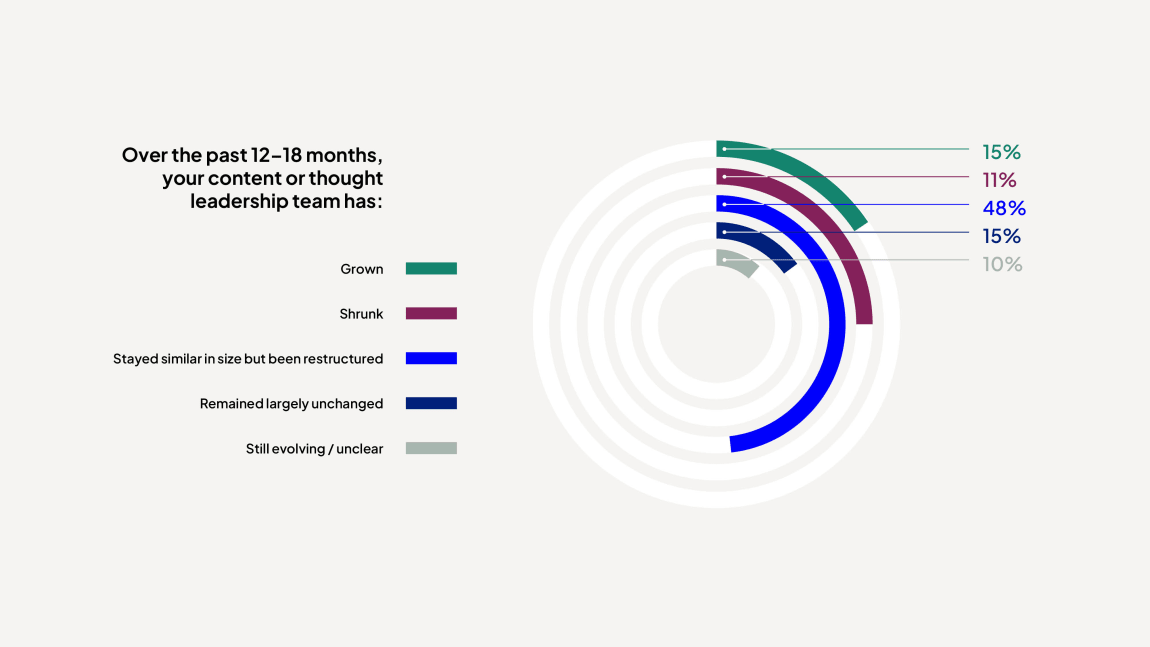
The most reassuring finding in our study, for anyone working in content marketing, is that teams are not shrinking, despite the increase in AI. Instead, they are being reshaped. Nearly half of respondents say their content or thought leadership functions have been restructured over the past 12 to 18 months, and only 11% report their teams have shrunk. The much-feared jobs apocalypse has not materialised.
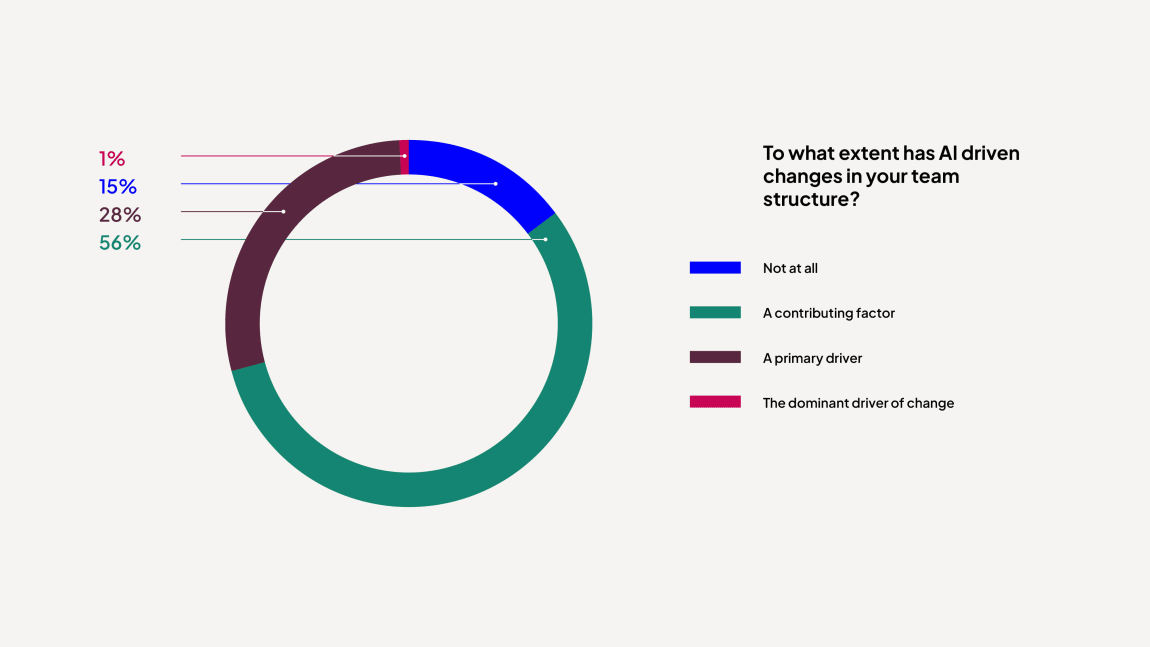
56% say AI is a contributing factor in changes to team structure. 28% say it is the primary driver. What started as a technology decision has become a catalyst for a much broader rethink of what a content function is actually for.
What leaders are actually hiring for
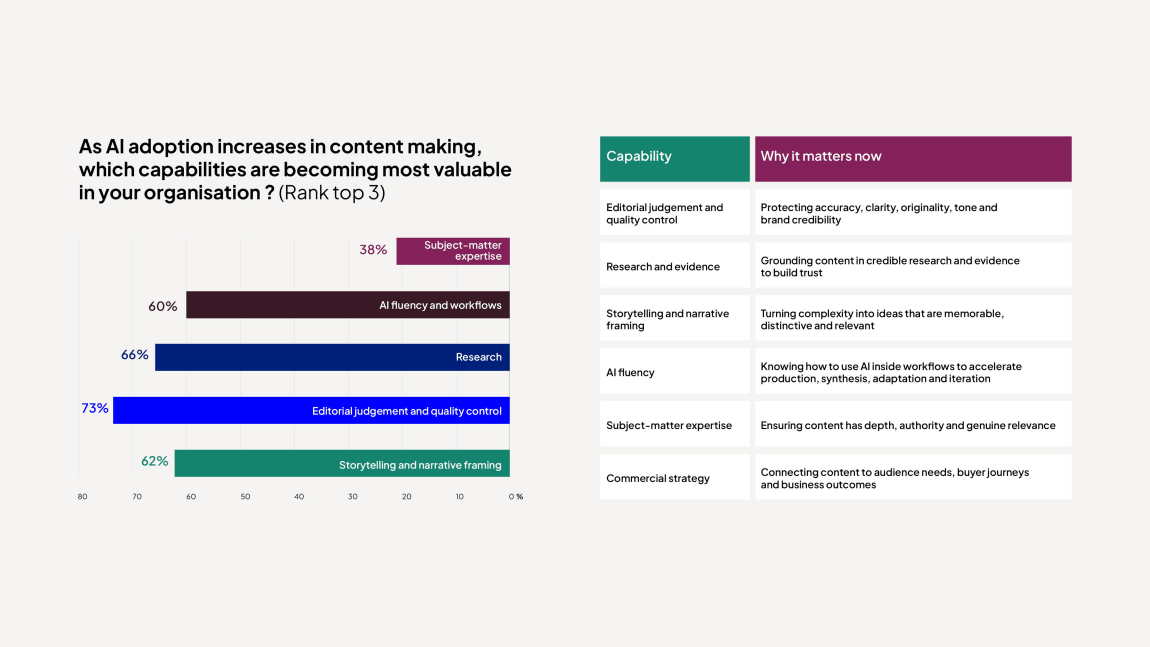
When we asked which capabilities are becoming most valuable as AI adoption increases, the answer was not what many would expect. Editorial judgment and quality control ranked first. Research ranked second. Storytelling and narrative framing followed closely. AI fluency came after all three.
That is not to say technical skills do not matter. They do. But the data suggests that leaders are increasingly aware that AI capability alone is not enough. When asked what causes problems with using AI for branded content creation, the top answer was a lack of originality or distinctive point of view, while 42% pointed to limited senior editorial or strategic oversight.
The more content production is automated, the more valuable it becomes to have people who can protect brand credibility, who know what good looks like, who know what to produce and, equally importantly, who know what to stop producing.
The leaders who understand this are not slowing down their AI adoption. They are pairing AI with stronger editorial oversight and determining who in the organisation has the research skills, the storytelling ability and the judgment to direct it well.
Senior marketerGlobal Marketing Leaders Content Study 2026AI is a great tool to complete all tasks, but it’s really important to have senior leadership and supervision in order to discern between good content and bad content, and to choose the best.
The differentiation factor
Satwant Wishart and Gareth Lofthouse discuss discuss what will set the strongest content teams apart, and why judgment, originality and storytelling matter more than ever.
Speakers: Gareth Lofthouse, Founder & MD, Resonant and Satwant Wishart, Founder & CEO, Pandher Wishart Studios
Gareth Lofthouse
First thing is good news, there isn't a job sort of apocalypse in the content team. There's very few, around about 10% say that their team has shrunk in the last 18 months.
However, let's not underestimate the scale of change underway. Nearly all teams are restructuring in some shape or form. What does this mean for the skill sets that companies are going to be investing in?
Satwant Wishart
So when we ask what were becoming most important to them, first, it was editorial judgment, then those with research skills and third, storytelling, and fourth, AI fluency. Those marketers who are going to have a job in a few years time, ultimately, they're going to be the ones who know what good looks like.
So using AI to create content, but having the ability to know when it's being generic, when we should use it, and when ultimately maybe we shouldn't be producing something as well.
Gareth Lofthouse
You've got to be super critical about anything you're getting back. That's not just is it factually accurate? Is it good enough? Is it interesting? Is it compelling? And those are only going to come from people with talent in the organisation to drive.
Satwant Wishart
And why storytelling is so important? Well, if we're struggling with differentiation, we need to be able to tell stories in order to be remembered, because when we are remembered, we are trusted.
Storytelling is our superpower
AI has made content cheaper, but originality more valuable
One of the most significant shifts we observed in this year's study is the growing recognition that storytelling is no longer a peripheral marketing skill. It is becoming a strategic capability and the market is beginning to price it accordingly.
Storytelling itself is nothing new, and has always been central to how humans connect and make sense of the world. Decades of research into how the human brain processes information consistently shows that we are wired to remember stories far better than statistics alone.
The historian Yuval Noah Harari goes further, describing storytelling as humanity's defining capability:
the ability to use narrative not just to entertain, but to rally people around ideas and inspire action.
In a market flooded with AI-generated content, that human capacity to make ideas memorable and meaningful has never mattered more.
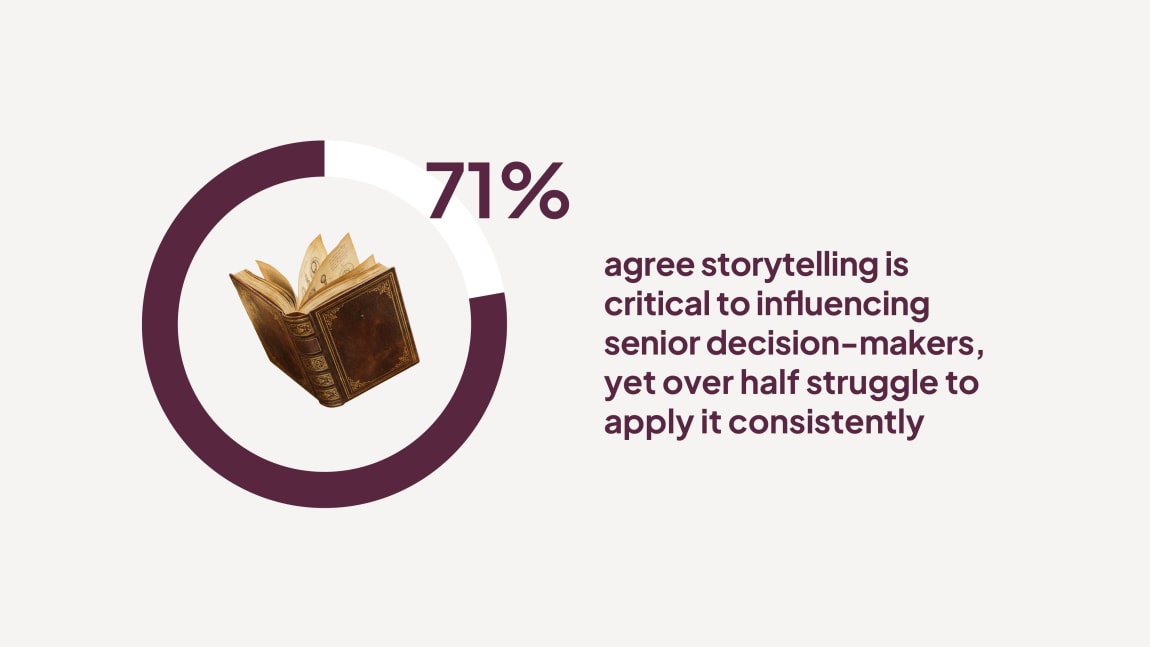
In our study, 71% of marketing leaders agreed that strong storytelling is critical to influencing senior decision-makers. Yet more than half say their organisation struggles to apply it consistently in practice.
The wider market is already responding. A recent Semrush analysis (1) of 8,000 US content marketing job listings found that storytelling appears in 29% of senior content marketing roles, up from just 8% three years ago. Senior ownership roles are also rising sharply, with Head of Content Marketing listings up 376%.
Meanwhile Business Insider has reported (2) that companies including Netflix, Microsoft, OpenAI and Anthropic are paying six-figure (and in some cases high-six-figure) salaries for roles centred around communication and storytelling.
Some organisations that replaced writers with AI are hiring them back, having found that what audiences value most cannot be generated at scale. It never could be. Expertise, shaped into an original story worth remembering, is what the market is now rewarding.
1 Semrush.com — Content Marketing Job Market Study
2 Business Insider — New class of AI jobs
Read next:
Chapter 2: Turning expertise into influence